
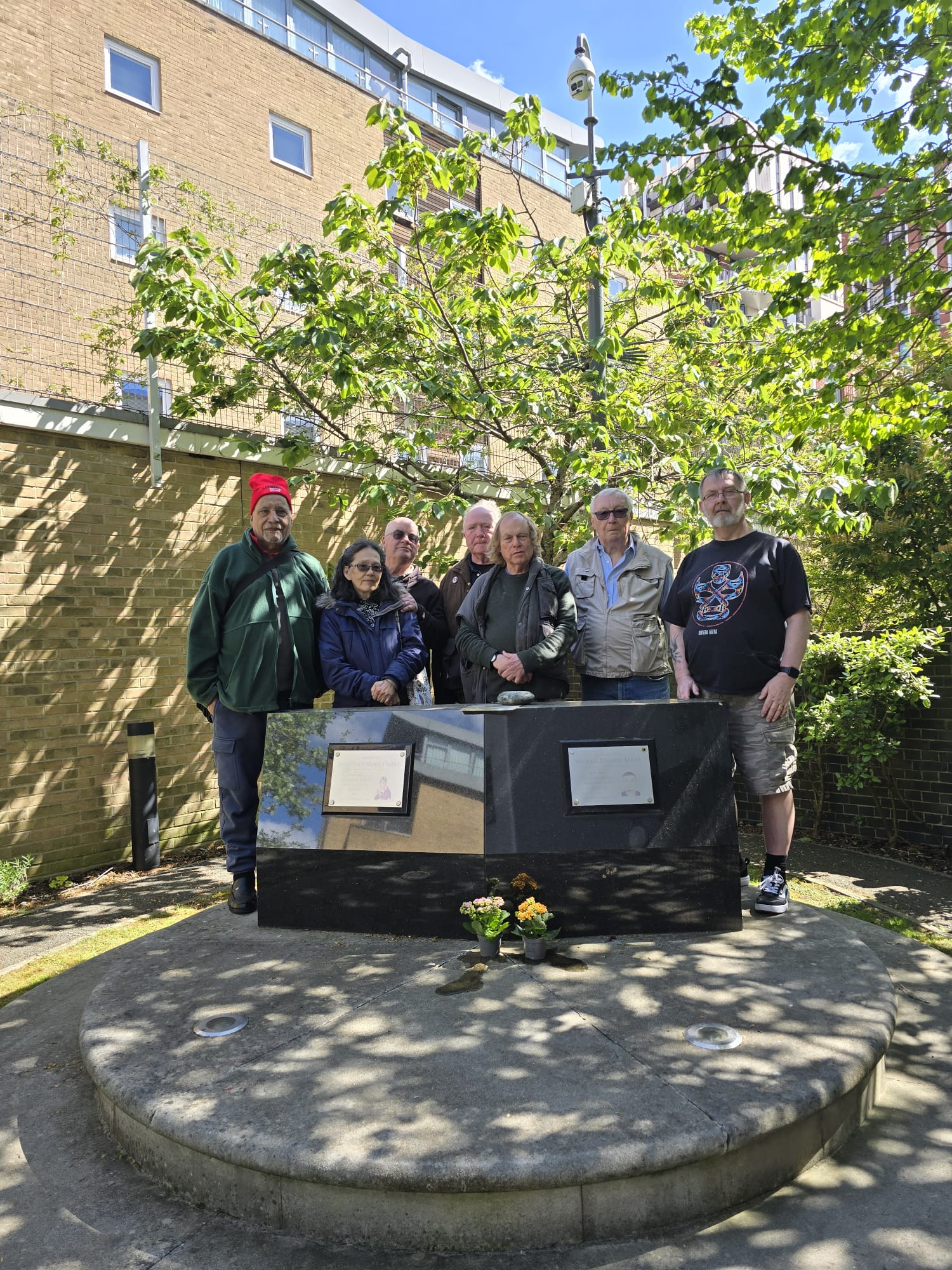
BWTUC AND UNITE CONSTRUCTION LONDON TO MARK TWENTIETH ANNIVERSARY OF BATTERSEA CRANE DISASTER WITH CAMPAIGN TO REINSTATE 2010 CRANE SAFETY LAW REPEALED IN 2013 AS ‘RED TAPE’
“The Labour Government must reinstate the 2010 law that requires careful inspection, maintenance and accountability for the operation of cranes so that no other families have to suffer pain like we have had to suffer”, says Liliana Alexa mother of son Michael killed in the disaster
Battersea and Wandsworth Trades Union Council and Unite London Construction Branch plan to mark the 20th anniversary of the Battersea Crane Disaster of 2006 by campaigning for the Labour Government to reinstate the 2010 law which was repealed in 2013 as unnecessary ‘red tape’.
On 26th September 2006, at approximately 5:30pm on a Barratt Homes construction site on Thessaly Road just across the road from Battersea Power Station site, a tragic and avoidable crane collapse took place.
There was a catastrophic failure of the 165ft tower crane which took the innocent lives of crane operator Jonathan Cloke, who died at the controls, and local bus driver Michael Alexa, who was crushed whilst changing a wheel on his car in the street below.
Investigatory findings by the Health and Safety Executive (HSE) later revealed that the collapse had been caused by metal fatigue across 24 slew ring bolts. Crucially, Falcon Crane Hire Ltd had failed to properly investigate a similar bolt shear on the exact same crane just nine weeks prior, exposing an inadequate and unacceptable system of fleet inspection and maintenance.
After a sustained campaign for a national crane register and inspection regime, led by BWTUC and Liliana Alexa, mother of Michael Alexa, Parliament in February 2010 adopted as law the Notification of Conventional Tower Cranes Regulations 2010 to give effect to the campaign’s demands. (See ‘Note to editors - 2’ below - copies of press releases for 2006 and 2010 with more information about this.
On 6 April 2013, under the guise of slashing ‘bureaucratic red tape’ following the Löfstedt Review, the Conservative and Liberal Democrat coalition government systematically abolished the national register. (For more information on this see ‘Note to editors - 2’ below, a copy of the 2013 press release
In an article in the Evening Standard in December 2012, Tory prime minister David Cameron declared his resolution ‘to kill off health and safety culture for good’ and concluded that health & safety ‘is an albatross around the neck of British business’.
BWTUC and the Unite Construction branch will join with Liliana Alexa at the memorial in Thessaly Road on 26 September 2026 to mark the twentieth anniversary of the disaster and to launch the campaign for the Notification of Conventional Tower Cranes Regulations 2010 to be reinstated by the Labour Government. (See ‘Notes to editors -1’ below for a statement by Liliana Alexa to mark the twentieth anniversary.)
Spencer Barnshaw, Secretary of BWTUC said:
“Battersea and Wandsworth Trades Union Council had a front row seat to see how proper attention to health and safety at the huge redevelopment of Battersea Power Station site led to its successful completion without a single serious accident or fatality. This was due to the partnership approach between the developers and Unite that successfully placed a very high priority on health and safety.
How different it was just across the road at the tiny by comparison Barratt Homes construction site where a crane in a desperately poor state of repair crashed to the ground causing two deaths and needless pain and suffering for the families of those killed.
BWTUC are marking this anniversary by launching a campaign for the reinstatement of the Notification of Conventional Tower Cranes Regulations 2010 which the Tory Party and Liberal Democrat Party repealed in 2013 on the spurious grounds that it was red tape. This legislation is not red tape. It’s needed to save families from pain like that suffered by Liliana.”
Liliana Alexa said:
“Carelessness can change lives forever. One moment of negligence can leave a family carrying a lifetime of grief. I hope that by remembering my son, we also remember our responsibility to one another to act with care, compassion, and respect for human life. This is why I and my family are supporting the campaign for the Labour Government to reinstate the 2010 law that requires careful inspection, maintenance and accountability for operating cranes so that no other families have to suffer pain like we have had to suffer.”
Kevin Williamson, Secretary of Unite London Construction Branch said:
“We want to see the 2010 law on crane safety reinstated by the Labour Government.
To promote health and safety on construction sites our branch is working with BWTUC to make a proper record of how the wonderful health and safety record at the nearby Battersea Power Station site was achieved in practice. We will make that record accessible to union representatives and contractor’s managers so that it can be emulated. This can be dedicated to and serve in the memory of Liliana’s son Michael.
We will step up our efforts to reinstate the crane regulations and also provide a proper record of the successful health and safety practices at Battersea Power Station site.”
End
Notes to editors
Note to Editors - 1
Statement by Liliana Alexa to mark the 20th anniversary of the crane disaster.
Twenty years
It is hard to believe that two decades have passed since our son was taken from us because of someone's negligence. Time has moved forward, but a parent's love does not measure time in years. It measures time in birthdays missed, dreams that never had the chance to come true, and moments that should have been shared.
People often say that time heals. I have found that time does not erase the loss. Instead, it teaches us how to carry it. The pain changes, but it never disappears because love never disappears.
Today, I do not want my son to be remembered only for the way he died. I want him to be remembered for the life he lived - for his smile, his kindness, his laughter, his hopes, and the joy he brought to those who knew and loved him. Those memories are precious, and no act of negligence can take them away.
The tragedy that took his life reminds us that our actions matter.
Carelessness can change lives forever. One moment of negligence can leave a family carrying a lifetime of grief. I hope that by remembering my son, we also remember our responsibility to one another to act with care, compassion, and respect for human life. This is why I and my family are supporting the campaign for the Labour Government to reinstate the 2010 law that requires careful inspection, maintenance and accountability for operating cranes so that no other families have to suffer pain like we have had to suffer.
For our family, these twenty years have been filled with love, tears, resilience, and remembrance. We have learned to live with an empty chair, an unfillable space in our hearts, and countless unanswered questions. Yet we have also learned that love continues. It lives in our memories, in the stories we tell, and in the way we honour him every day.
To everyone who has stood beside us over these years, thank you. Your kindness has helped us through the darkest moments. To those who remember our son today, thank you for keeping his memory alive.
My son, you are loved as deeply today as you were twenty years ago. You are missed every single day. Not a day passes without you in our thoughts, and not a day will ever come when you are forgotten.
Your life mattered. Your memory matters. Your love remains with us forever.
End
Note to Editors - 2
Three press releases from BWTUC on the Battersea Crane Disaster.
2013 Press Release
STATEMENT FROM THE BATTERSEA AND WANDSWORTH TRADES UNION COUNCIL ON THE BETRAYAL OF PUBLIC SAFETY AND THE REPEAL OF THE TOWER CRANE REGISTER
Battersea and Wandsworth Trades Union Council (BWTUC), alongside the families of the Battersea Crane Disaster Action Group (BCDAG), marks the anniversary of the 2010 Tower Crane Register with a mixture of pride for what was achieved, and profound anger at its politically motivated dismantling.
On 22 February 2010, following years of relentless local and national campaigning by trade unionists, safety activists, and bereaved families, Parliament finally capitulated to demands for public accountability. The laying of the Notification of Conventional Tower Cranes Regulations 2010 was a milestone victory. For the first time, structural data, crane age, and safety check dates on construction sites were mandated to be held centrally by the Health and Safety Executive (HSE). It stripped away the veil of corporate secrecy that had directly contributed to the preventable deaths of Jonathan Cloke and Michael Alexa on Thessaly Road in 2006.
However, the lifespan of this crucial safety measure was cut short by political dogma. On 6 April 2013, under the guise of slashing ‘bureaucratic red tape’ following the Löfstedt Review, the coalition government systematically abolished the national register.
Representatives of the BWTUC stated at the time of the repeal:
“To label a safety database that protects construction workers and residential communities as 'unnecessary administrative burden' is an insult to the memory of those killed by poorly maintained machinery. The register did not create a burden; it created a baseline of corporate transparency. Scrapping it was a dangerous capitulation to the building lobby at the expense of public safety.”
The BWTUC maintains that the arguments used to scrap the register—namely that existing lifting regulations (LOLER) were sufficient—are fundamentally flawed. If existing regulations were sufficient, the Battersea disaster, and the string of crane collapses that preceded it across the UK, would never have happened. The register forced plant hire companies to know that their fleet data was visible, traceable, and subject to immediate scrutiny if a fault was discovered on a sister asset.
The fight did not end in 2013, nor does it end today. The BWTUC and BCDAG continue to assert that public transparency is a non-negotiable right for any community living under the shadow of a high-rise construction site. We call on future administrations to reverse this short-sighted deregulation and reintroduce a robust, publicly accessible tracking system for all heavy lifting machinery operating in residential areas.
Ends
2010 Press Release
BWTUC WELCOMES NEW TOWER CRANE REGISTER AS A TRIUMPH FOR PUBLIC SAFETY AND WORKER PROTECTION
LONDON The Battersea and Wandsworth Trades Union Council (BWTUC) and the Battersea Crane Disaster Action Group (BCDAG) enthusiastically welcome Parliament’s formal approval of the Notification of Conventional Tower Cranes Regulations 2010.
This historic legislative milestone creates a centralised, national register for tower cranes across the United Kingdom. For years, trade unionists and bereaved families have fought tirelessly against corporate secrecy in the construction sector. This register represents a monumental victory for public safety, site workers, and communities living under the shadow of high-rise construction developments.
The creation of the register is a direct legacy of the 2006 Battersea crane disaster on Thessaly Road, which tragically claimed the lives of crane operator Jonathan Cloke and local resident Michael Alexa. Had a transparent tracking system existed then, the catastrophic safety failures and neglected maintenance history of that crane would have been visible to regulators before it was too late.
Speaking on behalf of the BWTUC campaign, Julia Brandreth said:
“We welcome this legislation with a sense of relief and deep pride in our community’s resilience. This register strips away the anonymity enjoyed by negligent plant hire companies. It ensures that crane age, location, and safety inspections are documented clearly with the Health and Safety Executive. This is a vital first step toward ensuring an avoidable tragedy like Battersea never happens again.”
Liliana Alexa, mother of Michael Alexa and co-founder of the BCDAG, stated:
“While this law cannot bring my son back, it means our four-year battle for justice has delivered real change. Rogue contractors can no longer hide defective machinery or ignore warning signs. We will be watching closely to ensure the HSE strictly enforces these notifications, keeping families like ours safe.”
BWTUC highlights three critical benefits of the new regulatory framework:
· Forced Accountability: Contractors must notify the HSE within 14 days of a crane being thoroughly examined, making maintenance delays immediately visible.
· Public Reassurance: Local residents will finally have transparency regarding the safety status and structural integrity of massive industrial equipment operating over their homes.
· Preventative Oversight: Centralized data will allow regulators to spot fleet-wide patterns of component failure or metal fatigue before accidents occur.
BWTUC expresses its gratitude to the construction union UCATT, the wider trade union movement, and the local residents of Battersea and Wandsworth whose unwavering solidarity made this safety breakthrough possible.
Ends
2006 Press Release
BWTUC DEMANDS STRICTER TOWER CRANE SAFETY STANDARDS AND JUSTICE FOR THE VICTIMS OF THE BATTERSEA CRANE DISASTER
Battersea and Wandsworth Trades Union Council (BWTUC), alongside members of the Battersea Crane Disaster Action Group (BCDAG) and Unite Construction, continues its unwavering campaign to demand maximum accountability and safer construction environments following the tragic and avoidable crane collapse on Thessaly Road.
The catastrophic failure of the 165ft tower crane took the innocent lives of crane operator Jonathan Cloke, who died at the controls, and local bus driver Michael Alexa, who was crushed while changing a wheel on his car in the street below. Investigatory findings by the Health and Safety Executive (HSE) later revealed that the collapse was caused by metal fatigue across 24 slew ring bolts. Crucially, Falcon Crane Hire Ltd had failed to properly investigate a similar bolt shear on the exact same crane just nine weeks prior, exposing an inadequate and unacceptable system of fleet inspection and maintenance.
Julia Brandreth, representative of the BWTUC, previously stated:
“What has deeply outraged local residents and trade union members alike is the historical lack of stringent, mandatory regulation regarding the use, erection, and dismantling of tower cranes in residential areas. These are not isolated accidents; they are systemic failures of corporate oversight.”
Liliana Alexa, mother of Michael Alexa and Secretary of the BCDAG, commented:
“We cannot understand how these preventable incidents keep occurring across UK construction sites. Our families had to endure a decade-long fight just to see the company admit legal responsibility in court. No fine can replace a loved one, which is why we demand proactive government enforcement to ensure no other family suffers this agony.”
In response to the long-standing failures of the plant hire sector, BWTUC and its safety partners actively campaign for the following critical mandates:
· Compulsory Independent Inspection: A fully qualified state inspector must be physically present on-site every single time a tower crane is erected, altered, or dismantled.
· Enhanced Regulatory Frameworks: Tightening the Health and Safety at Work Act requirements to force companies to run exhaustive root-cause analyses whenever structural component strains or bolt failures are identified.
· Public Transparency: Total access to a comprehensive, publicly available register detailing crane maintenance histories, age, and operational logs to protect neighbouring residential blocks.
BWTUC stands firmly with the bereaved families and remains dedicated to transforming site safety from a corporate afterthought into a robustly enforced legal obligation.
ENDS

