
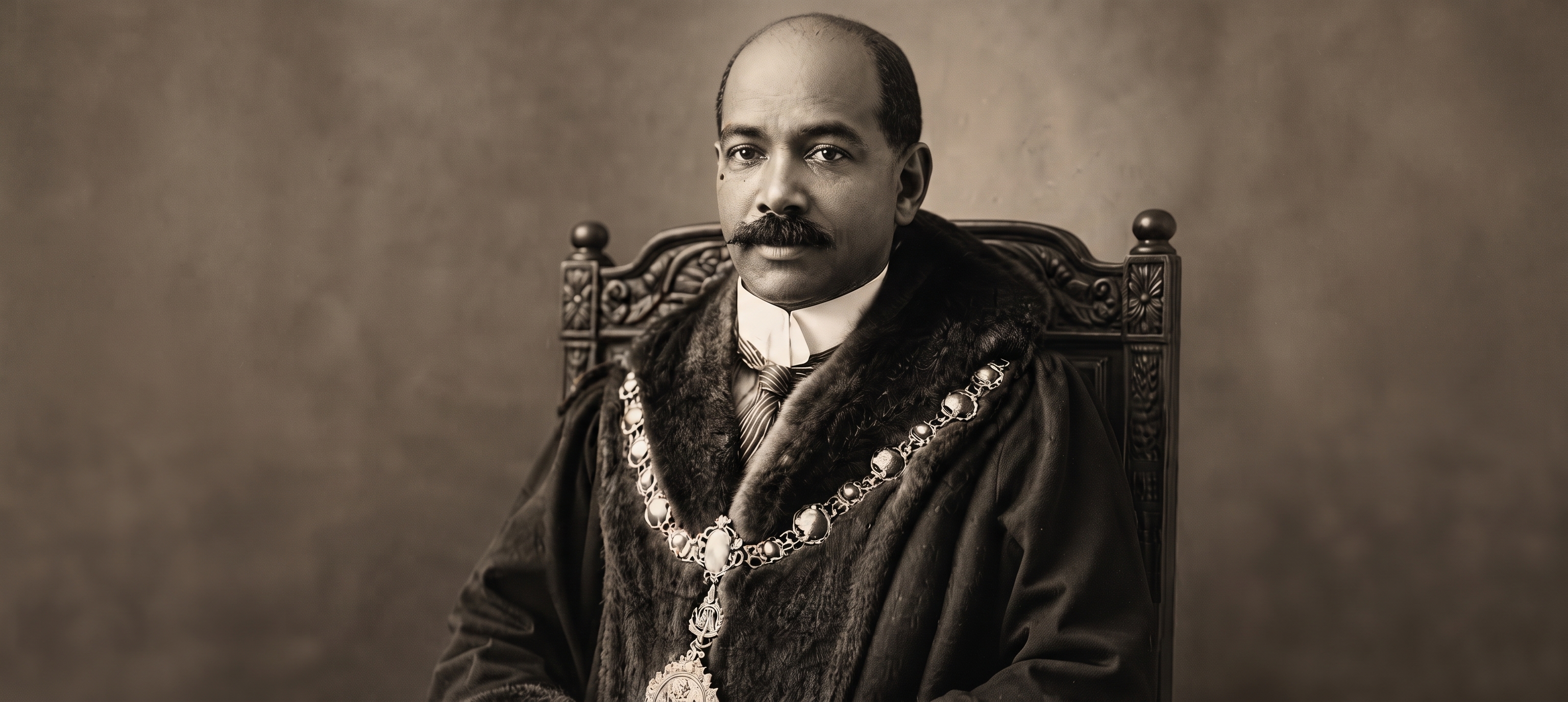
Battersea & Wandsworth Trades Union Council (BWTUC) encourages everyone to visit the exhibition celebrating the life and legacy of John Richard Archer, London’s first Black mayor, at Battersea Arts Centre this week.
John Richard Archer: Battersea’s Pioneering Black Mayor – An Exhibition at Battersea Arts Centre
Battersea & Wandsworth Trades Union Council (BWTUC) encourages everyone to visit the exhibition celebrating the life and legacy of John Richard Archer, London’s first Black mayor, at Battersea Arts Centre this week.
From seafarer to political pioneer
Born in Liverpool on 8 June 1863, John Richard Archer was the son of Richard Archer, originally from Barbados, and Mary Theresa Burns, from Ireland. Following in his father’s footsteps, he became a seaman, travelling extensively and spending time in the United States and Canada, where he married Margaret, a Black Canadian woman.
In the 1890s, the couple returned to England and settled in Battersea. Archer initially studied medicine while supporting himself through a small photographic studio. His political journey gathered momentum following the Pan-African Conference in London in 1900, where he met prominent figures from across the African diaspora.
A supporter of the radical Liberal politician John Burns, Archer became involved in Battersea’s vibrant progressive political movement, building relationships with local radicals and campaigning for social and economic reform.
In 1906, he was elected as a Progressive (Liberal) councillor for Latchmere ward on Battersea Borough Council. That same year, Henry Sylvester Williams, another leading Pan-Africanist, was elected to Marylebone Borough Council, marking an important moment in the representation of Black people in British local government.
Archer was a committed advocate for working people. Among his achievements was successfully campaigning for a minimum wage of 32 shillings a week for council workers. Although he lost his council seat in 1909, he was re-elected in 1912, continuing his work for social justice and equality.
Breaking barriers: London’s first Black mayor
In 1913, Archer was nominated for the position of mayor of Battersea. At the time, the mayor was not simply a ceremonial figure, as the office would largely become in later years, but also held significant political leadership responsibilities.
His nomination was met with racist opposition, including allegations questioning his British nationality. Despite these challenges, Archer secured the position by the narrowest of margins, winning 40 votes to 39 among his fellow councillors.
His election as London’s first Black mayor was a landmark achievement, not only for Battersea but for the wider struggle against racial discrimination and for political representation in Britain.
Archer continued to move towards the political left and, in 1919, was re-elected to the council as a Labour representative. By 1931, he had become deputy leader of the Labour group, demonstrating his enduring influence within Battersea’s political life.
Pan-Africanism, labour and international solidarity
Archer’s commitment to equality extended well beyond local politics. In 1918, he became the first president of the African Progress Union, an organisation promoting what it described as "advanced African ideas in liberal education".
In 1919, he represented Britain at the Pan-African Congress in Paris and, in 1921, chaired the Pan-African Congress in London. These events brought together campaigners and political thinkers seeking to challenge colonialism, racism and the inequalities faced by people of African descent around the world.
Archer’s political outlook was also firmly rooted in the labour movement. In 1922, he gave up his council seat to become the Labour Party election agent for Shapurji Saklatvala, a Communist Party activist standing in North Battersea. Archer played an important role in persuading the Labour Party to endorse Saklatvala, who was subsequently elected to Parliament, becoming one of the first Indian MPs in Britain.
The two continued to work together, securing another electoral victory in 1924, before the political relationship between Labour and the Communist Party broke down. In the 1929 general election, Archer acted as election agent for the official Labour candidate, who defeated Saklatvala.
Throughout his career, Archer held numerous positions of public responsibility, including governor of Battersea Polytechnic, president of the Nine Elms Swimming Club, chair of the Whitley Council Staff Committee and member of the Wandsworth Board of Guardians.
In 1931, he was once again elected to Battersea Council, this time representing Nine Elms ward. At the time of his death on 14 July 1932, he was deputy leader of Battersea Council.
His funeral took place at the Church of Our Lady of Carmel in Battersea Park Road on 19 July 1932, and he was laid to rest in the council cemetery at Morden.
Remembering John Archer in Battersea today
John Archer’s contribution to political life, the labour movement and the international struggle for racial equality deserves to be remembered and celebrated.
His legacy is recognised in Liverpool, where the John Archer Hall commemorates his connection to the city of his birth, and locally in Wandsworth, where John Archer Way bears his name.
In 2004, he was included in the 100 Great Black Britons list, and in April 2013, Royal Mail honoured him with a commemorative stamp as part of its Great Britons series. He is also remembered through two blue plaques: one established by the Nubian Jak Community Trust and another by English Heritage at his former home on Brynmaer Road, Battersea.
In March 2018, High View Primary School in Battersea was renamed Ark John Archer Academy, ensuring that future generations continue to learn about his life and achievements.
Battersea & Wandsworth Trades Union Council is proud to play a part in keeping Archer’s memory alive. Our Trades Council owns the Bread & Roses pub on Clapham Common, where a room has been named in his honour, recognising his contribution to the local community, the labour movement and the fight for equality.
Visitors to Archer’s grave will also find commemorative badges. Anyone visiting is welcome to take one, with the request that the pot and lid are replaced afterwards.
We also continue to preserve the work of the late local historian Sean Creighton, whose research and writing made an important contribution to documenting the lives of local political and social pioneers, including John Archer. Although Sean is sadly no longer with us, his work remains accessible through the BWTUC website.
Visit the exhibition
The First Among Equals: John Archer exhibition at Battersea Arts Centre offers an opportunity to learn more about the life of a man who challenged racial prejudice, championed working people and helped shape Battersea’s political history.
BWTUC encourages trade unionists, local residents and anyone interested in Black history, the labour movement and the struggle for equality to visit the exhibition and discover more about this remarkable local figure.
Exhibition: First Among Equals: John Archer – Battersea Arts Centre
Find out more:
John Archer’s story is one of determination, solidarity and progress. His achievements remind us that the fight for equality and justice has deep roots in Battersea and that the contribution of Black working-class leaders to our shared history must never be forgotten.

